Table of Contents

Everything you need to plan a safe, soulful, and unforgettable pilgrimage to the abode of Lord Shiva.
Introduction: Why Kedarnath?

There are trips you take — and then there is Kedarnath, a journey that stays with you long after your legs stop aching. Kedarnath is located in the Rudraprayag district and is the most remote of all Chota Char Dham sites. It sits near the Chorabari Glacier, which is the source of the Mandakini river, and the temple is flanked by snow-capped peaks, most prominently the Kedarnath peak (6,940 meters) and the Kedar Dome (6,831 meters) The Kedarnath Trek is not the trip through the Himalayas only; it is a religious pilgrimage to one of the 12 Jyotirlinga of Lord Shiva. Kedarnath Temple is located in the district of Rudraprayag of Uttarakhand at a height of 3,583 meters (11,755 ft) above the ground and is encircled by snow-clad mountains, glaciers, and the Mandakini River.
A little history that gives the place its soul: the town suffered extensive destruction during the devastating 2013 floods caused by cloudburst and torrential rains in Uttarakhand, yet the temple, built from massive grey stone slabs interlocked with iron clamps, magnificently survived the disaster.
Key Dates for 2026
Kedarnath Temple opened on 22 April 2026 and closes on 11th November 2026. The Kedarnath Yatra 2026 officially kicks off with the opening of Kedarnath Dham on 22 April 2026 at 08:00 AM, marking a historic moment for pilgrims after the long winter closure.
Here’s how it fits into the wider Char Dham circuit: this announcement comes as part of the broader Char Dham Yatra schedule, with Yamunotri and Gangotri opening earlier on 19 April and Badrinath following on 23 April 2026.
The reason for the seasonal opening? The Kedarnath Temple remains closed during winter due to heavy snowfall. The idol is shifted to Ukhimath during this period, and the temple usually reopens in April or May.
Registration: The Non-Negotiable First Step
Do NOT skip this — it is the single most important part of your planning. The Uttarakhand government and temple authorities have made registration compulsory for all pilgrims intending to trek or travel to Kedarnath in 2026. Without a valid registration pass, pilgrims will be stopped at checkpoints such as Sonprayag and will not be allowed to proceed to the Kedarnath Dham route.
Registration opened early this year: the Kedarnath Yatra 2026 registration start date was 6 March 2026, with the portal opening approximately 47 days ahead of the temple’s opening on 22 April 2026.
How to Register (3 Easy Online Options)
To complete Kedarnath yatra registration without visiting a physical counter, use one of three online options: the official portal at registrationandtouristcare.uk.gov.in, the Tourist Care Uttarakhand mobile app, or the WhatsApp registration service at +91-8394833833.
For the WhatsApp route: send the word YATRA to 8394833833 on WhatsApp, and the government’s automated chatbot guides you through a structured question sequence covering your name, travel date, chosen dham (select Kedarnath), and ID details.
Offline counters are also available for those who prefer them: 5pilgrims who cannot register online can complete biometric registration at official counters at Haridwar, Rishikesh, Guptkashi, Sonprayag, and Phata.
Pro Registration Tips
- The portal sees the heaviest traffic in the first week of March and again in late April as opening dates are confirmed. Registering between 5:30 AM and 7:30 AM IST — before office hours begin — gives you a significantly smoother experience on the server.
- Carry both a printed and a digital copy of your QR pass when you travel.
- There are no paid temple tickets required for darshan at Kedarnath — entry is free, but you must complete the mandatory yatra registration and carry your e-pass during the journey.
How to Reach Kedarnath (The Route)
The full road journey follows a scenic Himalayan trail. Here’s the classic route: Delhi → Haridwar → Rishikesh → Devprayag → Srinagar Garhwal → Rudraprayag → Guptkashi → Phata → Sonprayag → Gaurikund, with the total road distance from Delhi to Gaurikund being approximately 445 km and a driving time of 12–14 hours split across 2 days.
By Air
Jolly Grant is the nearest airport to Kedarnath, situated at a distance of 238 kilometers, and is well connected to Delhi with daily flights.
By Rail
The nearest railway station to Kedarnath is Rishikesh, situated 216 kilometers before Kedarnath on NH58, and is well connected by railway networks with major destinations of India.
Important Road Note
Private vehicles are not permitted beyond Sonprayag. From Sonprayag, pilgrims take a shared jeep or walk 6 km to Gaurikund, the trek base.
The Trek: Gaurikund to Kedarnath
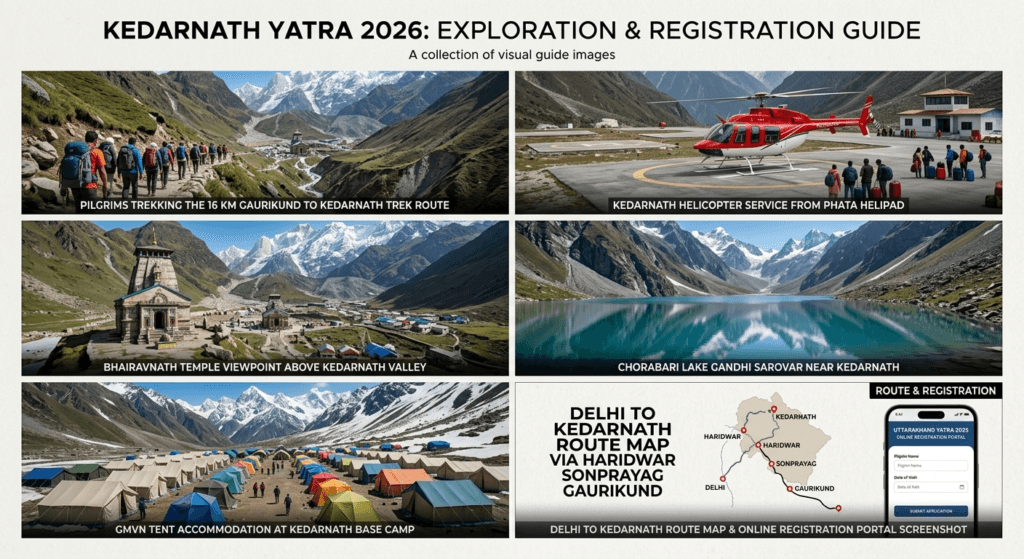
This is the heart of the pilgrimage. The last motor vehicle roadhead of the trek to Kedarnath is Gaurikund, where pilgrims start the scenic spiritual journey on foot. The walk between Gaurikund and Kedarnath spans around 16 kilometers and traverses stunning sceneries, waterfalls, and spots of rest including Jungle Chatti, Bheem Bali and Linchauli.
Distance & Duration: the trek from Gaurikund to Kedarnath covers 16 km through stunning Himalayan paths, usually taking 6–8 hours for fit trekkers, but beginners might need 8–10 hours.
Crucial Timing Rule: Trekking is permitted only between 4:00 am and 1:30 pm, as the route lies within the Kedarnath Wildlife Sanctuary.
Trek Alternatives (For Those Who Can’t Walk)
Helicopter services (Rs 8,800–12,500 round trip), palki (Rs 7,500–10,000 one way), and pony services (Rs 5,500–7,000 one way) are available for those who cannot trek. **Important:** book ponies, palanquins, and Kandi carriers only from official government counters to prevent scams.
Helicopter Option
The nearest helipads to Kedarnath are Phata, Sirsi (also spelled Sersi), and Guptkashi. Helicopters fly directly to the Kedarnath helipad — approximately 1–1.5 km from the temple. A word of caution on booking: beware of fraudulent agents claiming to provide helicopter tickets; use only the official booking portal.
Places to Cover: Must-Visit Spots
At Kedarnath Itself
1. Kedarnath Temple — the main shrine. The Kedarnath temple is one of the 12 Jyotirlingas of Lord Shiva and forms one of the four sites of the Char Dham pilgrimage. Built of large-sized rocks on a rectangular platform, the temple houses a Shiva Lingam in an unusual pyramidal form.
2. Bhairavnath Temple (Bhairon Baba) — the 800-m uphill trek from Kedarnath to Bhairavnath Temple falls on this route and offers magnificent views of the Kedarnath Temple and the verdant Kedarnath Valley.
3. Adi Shankaracharya Samadhi — one of the most popular attractions in Kedarnath, the Adi Shankaracharya Samadhi is believed to be the place where sage Adi Shankaracharya attained Moksha, located just behind Kedarnath temple.
4. Chorabari Lake (Gandhi Sarovar) — at a distance of 8 km from Kedarnath, this beautiful lake situated at an altitude of 4,135 m is where some of Mahatma Gandhi’s ashes were immersed in 1948.
Nearby Spots Worth Adding to Your Trip
1 Chopta Valley, often called the “Mini Switzerland of India,” is perfect for peaceful views and nature lovers; Tungnath Temple, known as the highest Shiva temple in the world, with stunning Himalayan views; Rudraprayag Sangam, a sacred meeting point of the rivers Alaknanda and Mandakini; and Badrinath Temple, yet another notable shrine in the Char Dham Yatra.
What to DO
- Attend the early morning Abhishek Puja. The Abhishek Puja at 4:30 AM — the ritual bathing of the Lord Shiva Jyotirlinga — happens with very few pilgrims present. This is the most spiritually significant experience of the entire Yatra, and day-trip pilgrims miss this entirely.
- Experience the quiet hours. Most pilgrims visit during the daytime rush, but between 4:30 AM and 6:30 AM the valley remains quieter, temperatures stay crisp, and the first sunlight falling on the snow-covered peaks creates one of the most peaceful moments of the yatra.
- Get a health check-up first. Get a full health check-up before starting — avoid the trek if you have severe asthma, uncontrolled heart problems, or uncontrolled high blood pressure.
- Train your body in advance. At minimum, spend 4–6 weeks before the trek doing daily 30–45 minute brisk walks and stair climbing, and start morning and evening walks to improve cardiovascular endurance.
- Stay hydrated & fuel up. Drink 3–4 litres of water daily, even if you don’t feel thirsty in cold weather, and eat light carbohydrates like jaggery or dry fruits every hour.
- Acclimatize. Arrive one day early at Sonprayag or Gaurikund for acclimatization.
- Pack proper warm gear. Always carry proper winter clothing even in summer, including gloves, warm inner layers, trekking shoes, and windproof jackets, because cold winds and sudden weather changes are common.
- Carry a BSNL SIM. BSNL has the most reliable coverage at Kedarnath and along the Char Dham route. Jio works intermittently on the trek route and at the temple base, while Airtel and Vi have limited to no coverage beyond Guptakashi.
- Inform family & carry a power bank. Inform your family about your itinerary before starting the trek, and carry a power bank as charging points are limited at Kedarnath base.
What NOT to Do
- Don’t visit during the monsoon. Visiting Kedarnath during monsoon (July–August) is not recommended due to the high risk of landslides, flash floods, and trail damage — the 2013 disaster is a reminder of how severe the weather can get.
- Don’t carry phones/cameras into the temple. In a landmark decision ahead of the 2026 season, mobile phones and cameras are strictly banned inside the Kedarnath Temple complex — this includes photography, filming, social media reels and video recordings during darshan.
- Don’t book through unofficial agents. Do not collect your Yatra Registration Number from travel agents or unofficial sources — register only through the official government portal. Also, avoid fake websites asking for registration fees, since registration is generally free.
- Don’t expect luxury. All the stays and food are extremely basic; the geyser is a big luxury, so don’t expect running hot water or room service — getting to sleep on a bed at that height is enough in itself.
- Don’t carry alcohol or non-veg food. Due to being a revered religious place, alcohol and non-vegetarian food is strictly prohibited at Kedarnath.
- Don’t rely on your phone for emergencies. During peak season, even BSNL can get congested due to the sheer number of pilgrims, so do not rely on the mobile network for critical communication.
- Don’t rush at high altitude. Keep basic medicines and a small first-aid kit, stay hydrated throughout the trek, and avoid rushing at high altitude.
Where to Stay
At Kedarnath itself, accommodation is simple. There is a big Govt tented colony consisting of tents, cottages, and rooms just before Kedarnath, operated by GMVN, which are sufficient to accommodate more than a thousand pilgrims. There are also many hotels and lodges around the temple.
A smart alternative: many pilgrims prefer staying overnight in Guptkashi, Sitapur, or Sonprayag to avoid last-minute room shortages near the trek route. Book early, because it is best to book your accommodation well in advance, especially in May–June, because hotels and camps fill quickly.
Best Time to Visit
For first-time travellers, avoid monsoon and aim for early May or September. The early-season charm is special too: during April and May, which is the opening season, temperatures range between 2°C to 12°C, snow is usually still present around the temple and nearby trails, and it’s a beautiful time to visit for those who love snow and peaceful early-season darshan.
Good to Know: Daily Pilgrim Caps
Plan early because entry may be limited. The Uttarakhand government has periodically imposed daily caps on Kedarnath pilgrim entries to manage crowd pressure and safety. The limit has varied between 12,000–15,000 pilgrims per day in recent seasons, so register early on the official portal to secure your slot, especially for peak May–June dates.
Final Thoughts
Kedarnath is not merely a destination — it is a test of endurance and a reward for the soul. Nestled at an altitude of 3,583 metres amid rugged peaks, this journey tests physical endurance and nourishes spiritual devotion in equal measure.
With mandatory registration completed, warm clothes packed, and your body prepared, you’re ready to answer the call of the mountains. Har Har Mahadev! 🙏
Note: Always verify the latest dates, registration rules, and helicopter fares on the official Uttarakhand government portal (registrationandtouristcare.uk.gov.in) before you travel, as they are revised annually.