Table of Contents
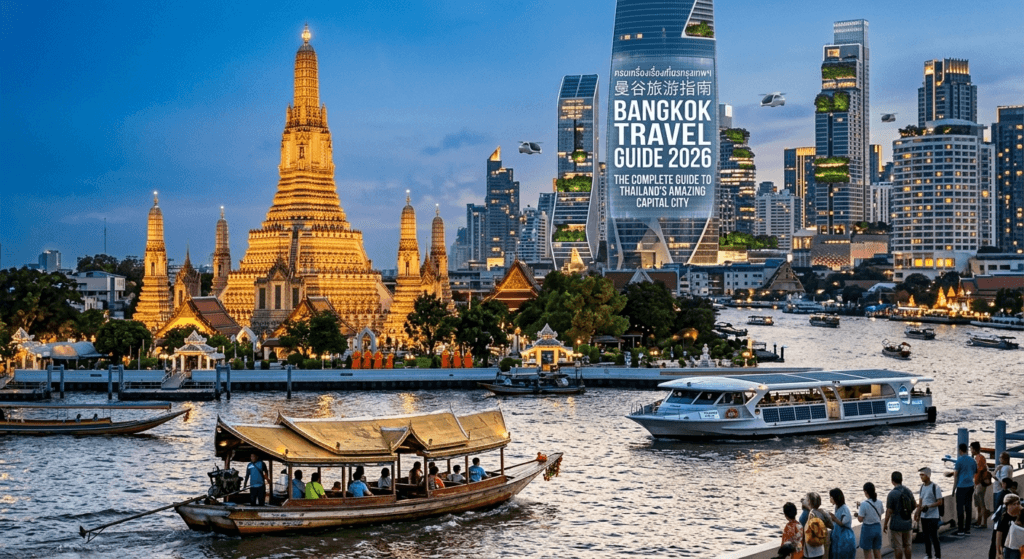
Everything you need to know about visiting the most visited city in the world — where to go, what to eat, how much to budget, and insider tips for an unforgettable Bangkok adventure.
Bangkok Travel Guide 2026: Why Every Traveler is Choosing Thailand’s Capital
Welcome to the ultimate Bangkok Travel Guide 2026—your complete resource for planning an unforgettable trip to Thailand’s incredible capital city. Bangkok is officially one of the world’s most searched and visited destinations, and it truly deserves every bit of the attention.
This isn’t just another big city. Bangkok is a place where ancient Buddhist temples stand alongside gleaming skyscrapers, where you can enjoy a $1 bowl of noodles for breakfast and sip cocktails at a rooftop bar 60 floors above the city by sunset. Locals call it “Krung Thep,” meaning “City of Angels,” and after spending time here, you’ll quickly understand why.
Whether you’re visiting for 3 days or 3 weeks, this Bangkok Travel Guide 2026 has everything you need to plan the perfect trip. You’ll discover the best temples, must-visit attractions, famous street food, vibrant night markets, realistic travel budgets, visa requirements, transportation tips, and the most common mistakes to avoid—so you can experience Bangkok like a smart traveler.
Best Time to Visit Bangkok
November to February: Peak Season (BEST TIME)
The best time to visit Bangkok is during the cooler season between November and February, with more comfortable weather, lower humidity and temperatures.[9]
Pros:
- Comfortable temperatures (20-27°C / 68-80°F)
- Low humidity makes walking around much easier
- Clear blue skies perfect for photos
- All outdoor activities are enjoyable
Cons:
- Hotels cost 30-50% more
- Popular attractions get crowded
- Book accommodation 2-3 months ahead[2]
March to May: Hot Season
March and April get seriously hot — we’re talking 35-40°C (95-104°F). But if you can handle the heat, you’ll find better hotel deals.
April highlight: Come in mid-April to join in with the water fights and colourful festivities of Songkran, Thailand’s new year celebrations.
June to October: Rainy Season
Don’t let “rainy season” scare you off. Even during the rainy season, showers are often short and followed by sunshine. Hotels are cheapest, and the city feels less touristy. Rain usually comes in heavy bursts in late afternoon, then stops.
Visa Requirements: The Good News
Here’s what makes Bangkok so easy to visit:
Visa-Free Entry for Most Travelers
If you’re from the US, Canada, UK, EU, Australia, or 88 other countries – NO visa needed! You get 60 days completely FREE when you arrive in Bangkok.
Important 2026 Update: There’s been discussion about reducing this to 30 days, but as of now, most Western travelers still get 60 days visa-free.
Passport Requirements
Your passport must be valid for at least six months beyond your intended departure date from Thailand.
Thailand Digital Arrival Card (TDAC) — MANDATORY
This is the ONE thing you absolutely must do before you fly: Just complete the Thailand Digital Arrival Card (TDAC) online within 72 hours before your flight.
How to do it:
- Go to tdac.immigration.go.th (it’s free — don’t pay scam websites!)
- Fill in your passport details, flight info, and accommodation
- Save the QR code to your phone
- Show it at immigration when you arrive
Proof of Funds
Official requirement: 20,000 THB (~$550) per person and 40,000 THB for a family entering on visa exemption. Rarely checked, but have cash, credit cards, or bank statement on phone just in case.[11]
Getting to Bangkok
By Air
Bangkok has two airports:
Suvarnabhumi Airport (BKK) — The main international airport.[11] This is where most long-haul flights land. Modern, efficient, well-connected to the city.
Don Mueang Airport (DMK) — Budget airlines and regional flights.[11]
From Suvarnabhumi to the City:
- Airport Rail Link — Fast train to the city center (45 minutes, ฿45/$1.30)
- Taxi — Metered taxis cost ฿300-400 ($9-12) plus ฿50 airport surcharge and tolls
- Grab (like Uber) — Similar price, book via app
How Much Does Bangkok Cost? The Real Numbers
Let’s talk money. Bangkok is affordable, but the cost depends entirely on how you travel.
Daily Budget Breakdown
In Bangkok, budget travelers spend $39 (฿1,255) per day on average, mid-range travelers spend $103 (฿3,344) per day, and luxury travelers spend around $289 (฿9,425) per day.[39]
Here’s what that actually looks like:
Budget Travel: $20-40/day (฿700-1,400)
- Accommodation: Hostel dorm bed ฿300-500 ($9-15)[39]
- Food: Most Bangkok street food costs locals ฿40–฿70 per dish.[35] Three meals = ฿150-250 ($5-7)
- Transport: BTS/MRT day pass ฿140 ($4) or pay-per-ride[43]
- Activities: Free temples, parks, and markets
You can do: Street food for every meal, public transport only, free attractions, hostels
You can’t do: Air-conditioned restaurants, taxis, paid attractions, private rooms
Mid-Range Travel: $60-120/day (฿2,000-4,000)
- Accommodation: Clean 3-star hotel with pool ฿1,200-2,200 ($35-65)
- Food: Mix of street food and restaurants ฿800-1,200 ($25-35)
- Transport: BTS/MRT plus occasional Grab rides ฿200-400 ($6-12)
- Activities: Grand Palace, temples, river cruise ฿300-500 ($9-15)
You can do: Comfortable hotels, restaurant meals, tourist attractions, mix of transport
This is the sweet spot for most travelers — you get comfort without overspending.
Luxury Travel: $150-300+/day (฿5,000-10,000+)
- Accommodation: 5-star riverside hotel ฿3,500-12,000+ ($100-350+)
- Food: Fine dining, rooftop bars ฿2,000+ ($60+)
- Transport: Private driver all day ฿2,500-4,000 ($75-120)
- Activities: Private tours, spa treatments, premium experiences
Sample Week Costs:
- Budget: $140-280 total
- Mid-Range: $420-840 total
- Luxury: $1,050-2,100+ total
Specific Prices to Know (2026)
The Grand Palace entrance fee is 500 baht (~ 14 EUR / 15 USD) per person in 2026.
Wat Pho entrance fee is 300 baht (~ 8 EUR / 9 USD) per person in 2026.[21]
Mango sticky rice: 150–200 THB (≈ USD 5–6). Noodle soup: Around 60 THB (≈ USD 2).
Must-Visit Places in Bangkok
1. The Grand Palace & Wat Phra Kaew (Temple of the Emerald Buddha)
This is THE Bangkok icon. Built in 1782, the sprawling complex served as the royal court and official residence of the kings of Thailand for almost 150 years, and today continues to host royal Thai functions while impressing visitors with its intricate golden-spired architecture.
The Emerald Buddha inside Wat Phra Kaew is Thailand’s most sacred religious object.
Tips:
- Go right at 8:30 AM opening to beat crowds
- Shoulders and knees must be covered. Sarongs are typically available for rent or purchase nearby if you don’t have appropriate clothing.
- Budget 2-3 hours minimum
- Entrance: ฿500 ($15)
2. Wat Pho (Temple of the Reclining Buddha)
Right next door to the Grand Palace. In addition to housing the gilded, 46-metre-long reclining Buddha, Wat Pho is home to Thailand’s largest collection of Buddha statues and is also known as the birthplace of traditional Thai massage.[21]
That reclining Buddha is HUGE — 46 meters long and covered in gold leaf.[24] You can also get an authentic Thai massage here at the massage school.
Cost: ฿300 ($9)[21]
3. Wat Arun (Temple of Dawn)
The Temple of the Dawn or Wat Arun towers 260 ft above the Chao Phraya River, and with fabulous views of the rising and setting sun, the temple is one of Bangkok’s major tourist attractions after the Grand Palace.
Cross the river on the tiny ferry (฿5) and climb the steep steps for incredible views. The colorful porcelain decorations sparkle in the sunlight — it’s one of the most photogenic temples in Thailand.
4. Chatuchak Weekend Market
One of the world’s largest outdoor markets, open Saturday and Sunday, with clothing, antiques, ceramics, plants, and street food — it has everything.
Seriously, this market has over 15,000 stalls. You could spend an entire day here.
Pro tip: Go early — by midday the heat is punishing and the crowds multiply. Most vendors are set up by 9 AM, and the sweet spot for comfortable browsing is between opening and 11 AM.
5. Bangkok’s Night Markets
Night markets are where Bangkok truly comes alive.
Top picks for 2026:
Jodd Fairs Ratchada — Now boasting over 1,500 stalls, it perfectly balances a hipster-chic aesthetic with high-quality offerings where you can indulge in famous “Volcanic Pork Ribs” or fresh oysters while enjoying live music.
Asiatique the Riverfront — Seamlessly blends a night bazaar with an open-air mall, situated majestically along the Chao Phraya River with high-end dining, boutique shopping, and the iconic Ferris wheel, arriving via private boat shuttle.
Train Night Market Ratchada — After a brief hiatus, the Train Night Market Ratchada is back with its iconic multicolored tents and remains the best place to capture that quintessential “Bangkok from above” photo.
Khao San Road — Part market, part open-air party, with street vendors selling everything from elephant pants to fried insects alongside pad thai carts and cheap cocktail buckets, with market energy peaking after 9 PM.
6. Chinatown (Yaowarat)
Bangkok’s Chinatown strip comes alive at night when neon signs flicker on and food carts line both sides of the road, with grilled seafood, roast duck, and mango sticky rice — all at a fraction of restaurant prices.
This is where locals go to eat. Most Bangkok street food costs locals ฿40–฿70 per dish, but in tourist-heavy areas, the same meal often costs ฿100–฿180. Chinatown is local prices.
7. Chao Phraya River
Alive with traditional long-tail boats, passenger ferries, and cargo boats, the Chao Phraya River is the lifeblood of the city, winding past both ancient temples and modern high-rises.
Take the public ferry (฿15-40) instead of expensive tourist boats — same views, way cheaper.
8. Lumpini Park
Get up before sunrise to head off to this park — so beautiful and quiet although soon fills up with runners and walkers, with beautiful flowers and scenery, a nice sunrise, and loads of sunflowers.
Free to enter, perfect for morning jogs or afternoon chill time. You might spot giant monitor lizards — they’re harmless but impressive!
9. Rooftop Bars
Bangkok’s skyline is best enjoyed from above. Famous rooftop bars include Sky Bar at Lebua (from “The Hangover 2”), Octave at Marriott Sukhumvit, and Vertigo at Banyan Tree.
Budget tip: You don’t have to drink alcohol — order a mocktail or soda and enjoy the ฿200-300 million-dollar view for ฿200-400.
10. Jim Thompson House
A former royal residence featuring traditional teakwood houses with a personal collection of fine arts and antiques.[25] Beautiful, peaceful, and air-conditioned — a nice break from the heat.
What to Eat: Bangkok Street Food Guide
Bangkok might be the street food capital of the world. Bangkok is often called the street food capital of the world, and the city’s sidewalks are alive with flavors that tell the story of Thai culture.
Must-Try Dishes
Pad Thai — Stir-fried rice noodles with egg, tofu or shrimp, peanuts, and lime. The most famous Thai dish for a reason. Street price: ฿50-60.
Tom Yum — Hot and sour soup with prawns, lemongrass, and chili. The standard Tom Yum is ~$2.58 / ฿84.
Som Tum — Green papaya salad. Spicy, tangy, refreshing. Ask for “mai phet” (not spicy) if you can’t handle heat.
Mango Sticky Rice — Sweet coconut rice with fresh mango. A Bangkok institution for ripe mango and creamy coconut rice, priced 150–200 THB.
Boat Noodles — Tiny bowls of rich pork or beef noodles priced 15–20 THB per bowl, with locals ordering 5–10 bowls per person!
Where to Eat
Street Stalls — Most Bangkok street food costs locals ฿40–฿70 per dish in residential areas, while tourist-heavy areas charge ฿100–฿180 for the same meal.
Food Courts — Shopping mall food courts like Pier 21 at Terminal 21 and MBK are excellent budget options offering clean, air-conditioned Thai meals from ฿50–100.
Restaurants — Casual restaurants usually charge THB 120–250 per meal, while upscale dining experiences can cost THB 500+
Is Street Food Safe?
Yes, if you choose busy stalls where food is cooked fresh. Always check cleanliness.
Look for stalls with lines of locals — that’s your best safety guarantee.
Getting Around Bangkok
Bangkok traffic is legendary (and not in a good way). Smart travelers use public transport.
BTS Skytrain
Elevated train covering major tourist areas. Clean, fast, air-conditioned. Bangkok’s BTS Skytrain provides safe and speedy ways to explore the city, as well as refreshing blasts of air-conditioning—wonderful during peak humidity.
Cost: ฿16-52 per trip, day pass ฿140
MRT (Metro)
Underground subway. The Bangkok MRT connects several important neighborhoods including Chinatown and Chatuchak Newer stations like Wat Mangkon have beautiful Chinese decorations.
Chao Phraya River Boats
The Chao Phraya River ferry is a great way to skip Bangkok’s notorious traffic jams and soak up riverside sights.Utilize the orange-flag Chao Phraya Express Boat for river transit instead of private tours to see the sights for a very low fixed fare.
Cost: ฿15-40
Taxis & Grab
Metered taxis start at ฿35. Always insist they use the meter. Grab (ride-hailing app) is more reliable and shows the price upfront.
Tuk-Tuks
The famous Tuk-tuk is one of the most recognizable symbols of Thailand. Although fun for short rides, they are usually more expensive than taxis and prices should be negotiated beforehand.
Price: ฿100-200 for short trips. Always agree on price BEFORE you get in.
What TO DO in Bangkok
- Visit temples early morning — Cooler, fewer crowds, more peaceful
- Eat street food — It’s safe, delicious, and the real Bangkok experience
- Use the BTS and MRT — Fast, cheap, air-conditioned
- Bargain at markets — Start at roughly half the asking price and work from there.[36]
- Try Thai massage — ฿200-300 ($6-9) for one hour at local shops
- Take the river ferry — Best way to see Bangkok from the water
- Go to a rooftop bar at sunset — The views are incredible
- Get a local SIM card — Buy an AIS or True tourist SIM at the airport for the best 5G coverage. Costs ฿200-500 for several GB
- Dress modestly at temples — Cover shoulders and knees
- Stay hydrated — Bangkok is HOT. Drink lots of water
What NOT to Do in Bangkok
- Don’t get into any tuk-tuk without agreeing on price first — Common scam
- Don’t believe anyone who says the Grand Palace is closed — Visitors should be cautious of common scams around the Grand Palace area, such as being falsely informed that the Palace is closed for a holiday and being redirected to other locations for shopping.
- Don’t take taxis that refuse to use the meter — Walk away and find another
- Don’t touch anyone’s head — It’s considered rude in Thai culture
- Don’t disrespect the Royal Family — Seriously, it’s illegal in Thailand
- Don’t drink tap water — Stick to bottled water
- Don’t wear shoes inside temples — You’ll have to take them off
- Don’t expect everything to run on time — “Thai time” is a real thing
- Don’t overpay in tourist areas — Tourist-focused areas including Khao San Road, Sukhumvit, and Silom feature prices 50-100% higher than local neighborhoods. Walk one street back and prices drop
- Don’t rely only on credit cards — Cash is still widely used for street food, markets, taxis, and small shops. Carry around THB 2,000–5,000 daily.
Where to Stay in Bangkok
Bangkok is HUGE — where you stay matters.
Sukhumvit — Best for First-Timers
Sukhumvit is a centrally located neighbourhood with easy access to other districts throughout Bangkok, ideal for first-time visitors, boasting historic and cultural attractions as well as great bars, restaurants and shopping.
Great nightlife, tons of hotels, excellent BTS access.
Riverside — Best for Romance
Peaceful, scenic hotels with river views. Perfect for couples. Catch the ferry to explore.
Old City (Rattanakosin) — Best for Culture
Close to the Grand Palace, Wat Pho, and historical landmarks, great for cultural travelers.
Silom — Best for Business & Shopping
A central area with a good mix of markets, temples, cafes, and modern business districts.
Khao San Road — Best for Backpackers
While Th Khao San is the most high-profile result of widespread independent travel, its bedbug-infested guesthouses of old have been replaced by boutique hotels and hip design bars thronged by flashpackers.
Weather Guide
- Hot: March-May (35-40°C / 95-104°F)
- Rainy: June-October (short afternoon showers)
- Cool: November-February (20-27°C / 68-80°F) ← BEST TIME
Fun fact: Even in “cool season,” Bangkok is still warm by most standards. Bring light, breathable clothes.
Money Matters
Currency: Thai Baht (THB or ฿)
Exchange Rate (2026): Around 32–35 baht to $1 USD.[45]
Where to Exchange Money:
- Airport (convenient but slightly worse rates)
- SuperRich (green or orange branches in the city — best rates)
- Banks (good rates, but need passport)
ATMs: Widely available, but charge ฿220 ($6-7) fee per withdrawal. Withdraw larger amounts less often.
Credit Cards: Accepted at hotels, malls, restaurants, and major attractions. But cash is king for street food and markets.
Health & Safety
Safety
Bangkok is generally very safe. Violent crime against tourists is rare. Main risks are:
- Petty theft (watch your bags in crowded areas)
- Taxi scams (use Grab or insist on meter)
- Tourist scams (fake Grand Palace closures, gem store scams)
Health
Travel insurance covering medical emergencies, hospitalisation, and evacuation is strongly recommended. Routine vaccinations are sufficient for most travelers. Thailand has excellent private hospitals, especially in Bangkok.
Emergency Numbers
- Tourist Police: 1155 (English spoken)
- Emergency Medical: 1669[15]
Staying Connected
Even budget hostels usually offer fast fiber. Buy an AIS or True tourist SIM at the airport for the best 5G coverage.
Cost: ฿200-500 for 5-15 days with several GB of data
WiFi is everywhere — cafes, malls, hotels, even some temples!
Sample Bangkok Itineraries
3-Day Bangkok Itinerary
Day 1: Old City Temples
- Morning: Grand Palace & Wat Phra Kaew (arrive 8:30 AM)
- Afternoon: Wat Pho (Reclining Buddha)
- Ferry across river to Wat Arun
- Evening: Riverside dinner or Asiatique night market
Day 2: Markets & Modern Bangkok
- Morning: Chatuchak Weekend Market (if weekend) OR Khlong Toei Market
- Afternoon: Shopping at Siam Paragon, CentralWorld
- Evening: Rooftop bar at sunset, then dinner in Sukhumvit
Day 3: Food & Culture
- Morning: Jim Thompson House
- Afternoon: Thai cooking class
- Evening: Chinatown (Yaowarat) street food tour
5-Day Bangkok Itinerary
Add to the 3-day plan:
Day 4:
- Morning: Lumpini Park walk
- Day trip to Ayutthaya ancient ruins (1 hour away)
- Evening: Thai massage
Day 5:
- Morning: Damnoen Saduak Floating Market (90 min from Bangkok)
- Afternoon: Relax at hotel pool
- Evening: Night market (Jodd Fairs or Train Market Ratchada)
Money-Saving Tips
- Eat at food courts — Eat at shopping mall food courts, such as Pier 21 at Terminal 21, where clean and air-conditioned street-style meals are sold at prices close to $1.89 / ฿61.[41]
- Use public transport — Use the BTS and MRT instead of taxis wherever possible. You’ll save money AND time
- Book hotels in advance — Book your hotel about three months in advance for the most popular luxury or boutique hotels, especially in December or January, for better chance of preferred room and best rates.
- Walk between nearby attractions — Grand Palace to Wat Pho is just a 5-minute walk
- Buy street snacks, not bottled drinks — Fresh coconut water or fruit smoothies cost the same as bottled water but taste way better
- Visit free attractions — Many temples, parks, and markets are free to enter
- Shop at local markets, not malls — Same products, half the price
Cultural Tips
- Smile — Thailand is called “Land of Smiles” for a reason. Smiling goes a long way
- Wai greeting — Put palms together and bow slightly. You’ll see Thais do this
- Be patient — Things move slower here. That’s part of the charm
- Learn basic Thai phrases:
- Hello: Sawasdee krap (male) / ka (female)
- Thank you: Kop khun krap/ka
- How much?: Tao rai?
- Not spicy: Mai phet
- Delicious: Aroi!
Final Thoughts: Is Bangkok Worth It?
Absolutely. Bangkok is one of the most exciting cities in Asia with its combination of historic temples, vibrant markets, modern shopping centers, rooftop bars, and incredible food making it a destination unlike anywhere else in the world.
Bangkok isn’t perfect — it’s hot, humid, chaotic, and overwhelming. The traffic is brutal. The crowds can be intense. And yes, you’ll probably get lost at least once.
But that’s what makes it incredible.
This is a city where you can watch monks chanting at sunrise, eat a $1 noodle soup that’ll blow your mind, explore a 200-year-old palace, ride a tuk-tuk through insane traffic, shop at a market the size of 27 football fields, and end your day with cocktails 60 floors above the city. Bangkok is currently the most visited city in the world. And after spending time here, you’ll understand exactly why.
So go. Book that flight. Try the street food. Get lost in the markets. Sweat through your shirt. Take way too many temple photos. And fall in love with the most chaotic, beautiful, delicious city in Southeast Asia.
References
The Poor Traveler – Bangkok Travel Guide
https://thepoortraveler.net/bangkok-travel-guide/ Bangkok Tourism Guide – 2026 Trip Planner
https://bangkoktourismguide.com Tourist Bangkok – Bangkok Travel Guide 2026
https://touristbangkok.com Expedia – Bangkok Travel Guide 2026
https://www.expedia.com.au/Bangkok.dx178236 Thailand Insider Guide – Bangkok Travel Guide
https://thailandinsiderguide.com/bangkok-travel-guide/ Voye Global – Bangkok 2026 Travel Guide
https://voyeglobal.com/bangkok-travel-guide-2026/ Bangkok Airways Blog – Bangkok Travel Guide 2026
https://blog.bangkokair.com/ Smart Life Thailand – Bangkok Travel Guide 2026
https://smartlifethailand.com/bangkok-thailand-travel-guide/ Visit Bangkok – Thailand Visa Guide 2026
https://visitbangkok.org/thailand-visa-guide-2026/ Embassy of India Bangkok – Travel Advisory
https://embassyofindiabangkok.gov.in/ 30 Sundays Club – Thailand Travel Guidelines 2026
https://30sundays.club/thailand-travel-guidelines-2026/ The Thaiger – Thailand Visa Requirements 2026
https://thethaiger.com/thailand-travel/thailand-visa-requirements-2026 North Abroad – Bangkok Travel Guide
https://northabroad.com/bangkok-travel-guide/ TripAdvisor – Best Things to Do in Bangkok
https://www.tripadvisor.com/Attractions-g293916-Activities-Bangkok.html Lonely Planet – 16 Best Things to Do in Bangkok
https://www.lonelyplanet.com/thailand/bangkok/attractions Thrillophilia – Places to Visit in Bangkok
https://www.thrillophilia.com/destinations/bangkok/places-to-visit Viator – Best Attractions in Bangkok 2026
https://www.viator.com/Bangkok/d343-ttd Berkeley Pratunam – 10 Best Bangkok Night Markets 2026
https://berkeleypratunam.com/bkk-night-market/ Hotel Clover Asoke – Top 5 Bangkok Night Markets 2026
https://asoke.hotelclover.com/bangkok-night-markets-guide/ BeYourGuides – Top Bangkok Street Food 2026
https://beyourguides.com/bangkok/top-bangkok-street-food/ Off Path Thailand – Bangkok Street Food Prices 2026
https://offpaththailand.com/bangkok-street-food-prices-2026/ Nomado Travel – Best Markets in Bangkok
https://nomadotravel.app/guides/best-markets-in-bangkok Budget Your Trip – Bangkok Travel Cost
https://www.budgetyourtrip.com/thailand/bangkok AirAsia – Bangkok Tourist Budget 2026
https://www.airasia.com/play/assets/blt0c95e1b1d72f3d57/how-much-to-bring-to-bangkok GoTripZi – Bangkok Thailand Daily Costs
https://gotripzi.com/destinations/bangkok-th/cost/ Machu Picchu – Bangkok Budget Guide 2026
https://machupicchu.org/bangkok-budget-guide-2026/ Off Path Thailand – Bangkok Trip Cost 2026
https://offpaththailand.com/bangkok-trip-cost-2026-daily-budget/ Travel Happy – How Much Money Do I Need For Bangkok
https://travelhappy.info/how-much-money-do-i-need-for-bangkok/