
Table of Contents

I’ll be honest with you. Three months ago, I watched my colleague Sarah—a talented graphic designer with 8 years of experience—get her workload cut in half. Not because she wasn’t good enough, but because an AI tool could now do in 3 minutes what took her 3 hours.
She didn’t lose her job, though. She evolved it.
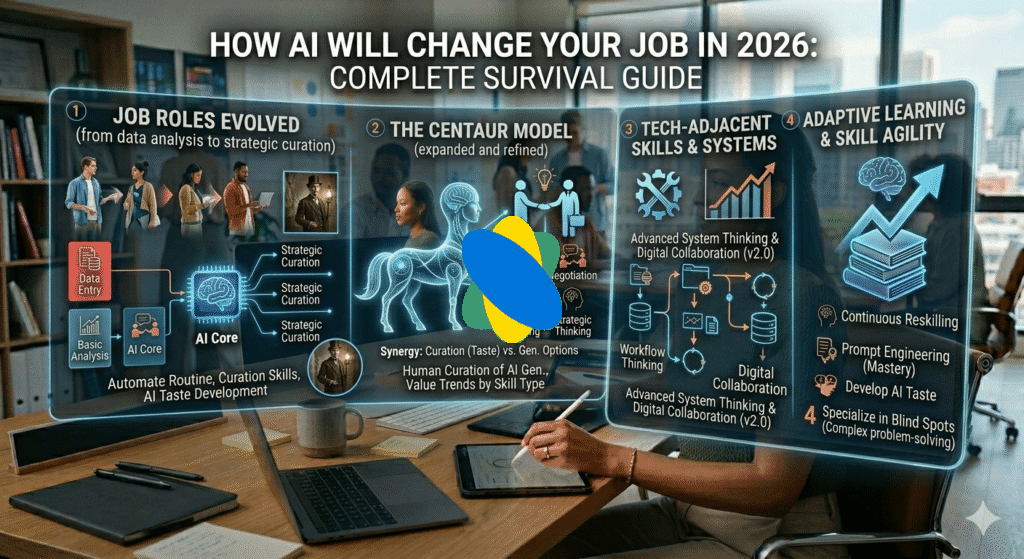
And that’s exactly what this guide is about—not fear-mongering, but real, practical strategies to make sure you’re not just surviving but thriving as AI reshapes the workplace in 2026.
The Reality Check: What’s Actually Happening Right Now
Let’s cut through the noise. AI isn’t coming for your job in some distant future—it’s already here, sitting in your office, and it’s more nuanced than “robots taking over.”
The Numbers Don’t Lie
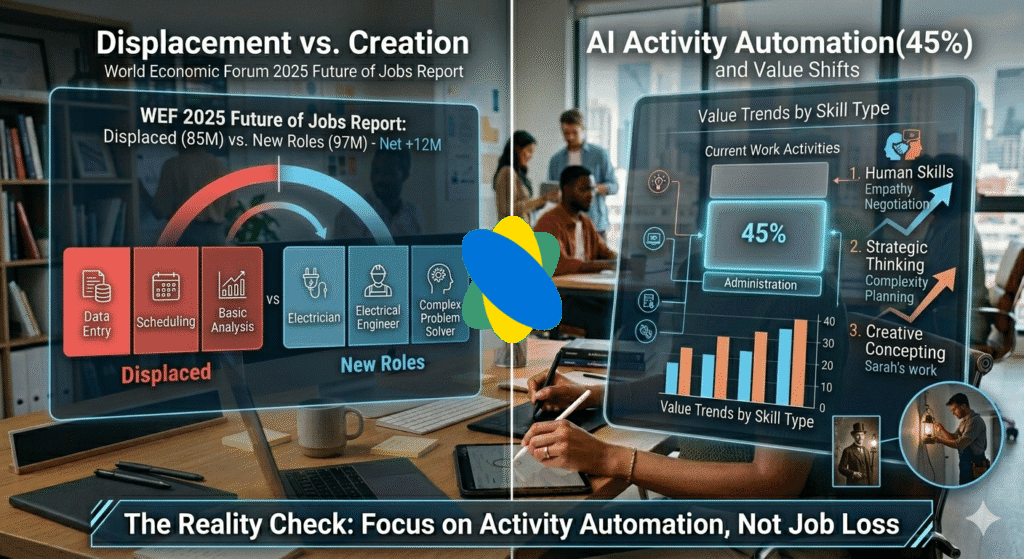
According to the World Economic Forum’s 2025 Future of Jobs Report:
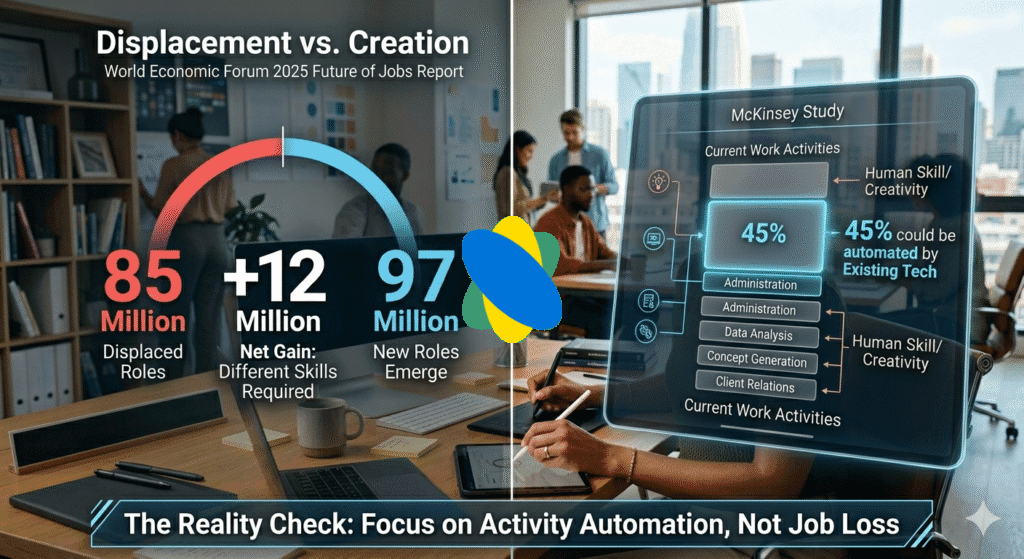
- 85 million jobs will be displaced by 2026
- BUT 97 million NEW roles will emerge
- Net gain: 12 million jobs (the catch? They require different skills)
A recent McKinsey study found that 45% of current work activities could be automated with existing technology. Not jobs—activities. This is crucial.
What This Really Means for You
Think of AI as electricity in the 1920s. It didn’t eliminate work—it transformed it. Lamplighters lost jobs, but electricians, electrical engineers, and appliance manufacturers emerged.
The pattern in 2026:
- Routine cognitive tasks → Being automated (data entry, basic analysis, scheduling)
- Creative + strategic thinking → More valuable than ever
- Human skills (empathy, negotiation, complex problem-solving) → Skyrocketing in demand
Jobs Most at Risk in 2026
I’m not here to sugarcoat this. Some roles are genuinely under pressure. But knowing is half the battle.
High-Risk Categories (60-80% of tasks automatable)
1. Data Entry Clerks & Administrative Assistants
Why at risk: AI can now process, organize, and input data with 99.9% accuracy.
Real example: Tools like Notion AI and Zapier are already handling scheduling, email sorting, and database management.
Your move: Transition into executive assistance (high-touch client relations), project management, or operations coordination—areas requiring judgment calls.
2. Customer Service Representatives (Basic Tier)
Why at risk: ChatGPT-powered chatbots now handle 70% of customer queries effectively.
The twist: Complex complaints, empathy-requiring situations, and VIP customer relations still need humans.
Your move: Specialize in customer success, relationship management, or become the “escalation expert” who handles what AI can’t.
3. Basic Bookkeepers
Why at risk: AI tools like QuickBooks AI and Xero automate invoicing, reconciliation, and reporting.
Your move: Become a financial advisor, forensic accountant, or specialize in tax strategy—areas needing interpretation and planning.
4. Telemarketers & Cold Callers
Why at risk: AI voice agents are now indistinguishable from humans (check out Bland AI or Air.ai).
Your move: Shift to consultative sales, B2B relationship building, or customer retention strategies.
5. Basic Content Writers & Copywriters
Why at risk: AI generates blog posts, product descriptions, and social media content in seconds.
But here’s the truth: AI content is generic. Strategic content that requires brand voice, persuasion psychology, and storytelling? Still human territory.
Your move: Specialize in content strategy, brand storytelling, or conversion optimization.
Medium-Risk Categories (30-50% of tasks automatable)
- Paralegals (legal research automated, but case strategy isn’t)
- Accountants (tax prep automated, but planning and advisory growing)
- Radiologists (AI detects anomalies, but diagnosis and patient communication remain human)
- Market Research Analysts (data collection automated, but insight generation isn’t)
- Translators (basic translation automated, but cultural nuance and localization need humans)
Jobs That Are AI-Proof (For Now)
Some roles are actually growing because of AI, not despite it.
The Untouchables
1. Skilled Trades
Plumbers, electricians, HVAC techs, carpenters—AI can’t fix your toilet or rewire your house.
Why safe: Physical dexterity + problem-solving in unpredictable environments = robot kryptonite.
Bonus: These jobs can’t be outsourced and pay incredibly well (median: $55k-$95k).
2. Healthcare Providers (Nurses, Therapists, Doctors)
Why safe: Patients want human empathy, touch, and judgment in health decisions.
AI assists with diagnostics, but the bedside manner and complex decision-making? That’s you.
3. Creative Strategists
Not just “creatives”—but people who strategize creativity.
- Brand strategists
- Creative directors
- UX researchers (understanding human behavior)
- Storytellers and content strategists
Why safe: AI can execute; it can’t truly innovate or understand cultural context.
4. AI Trainers, Ethicists & Managers
The irony? The rise of AI creates jobs managing AI.
- Prompt engineers (yes, this is real—salaries: $150k-$350k)
- AI ethicists
- Machine learning operations specialists
- AI content editors
5. Sales & Relationship Roles
High-ticket sales, B2B partnerships, client management—these require trust-building AI can’t replicate.
6. Teachers & Educators (With a Twist)
AI can deliver information, but it can’t inspire, mentor, or adapt to individual learning styles emotionally.
The evolution: Teachers become “learning experience designers” and mentors.
The Skills Gap: What You Need to Learn TODAY
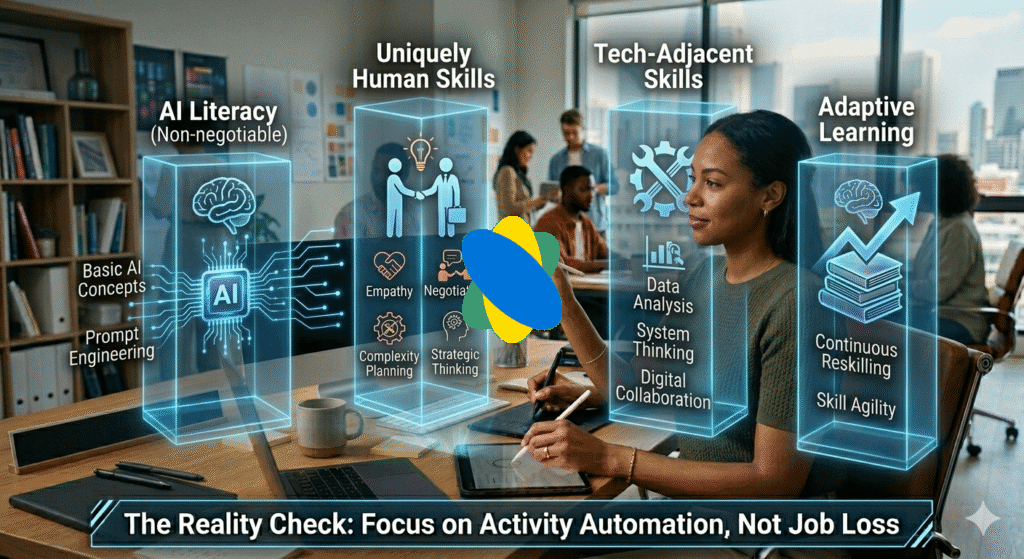
Here’s what separates those who thrive from those who struggle in 2026.
The 4 Pillars of AI-Era Skills
Pillar 1: AI Literacy (Non-negotiable for everyone)
You don’t need to code, but you MUST understand:
- How to write effective prompts (prompt engineering basics)
- Which AI tools do what
- AI’s limitations (so you know when NOT to use it)
Action step: Spend 30 days using ChatGPT, Claude, or Gemini daily. Learn prompting frameworks like:
- RICE (Role, Input, Context, Expectation)
- Chain of Thought prompting
- Few-shot learning
Free resources:
- Learn Prompting (learnprompting.org)
- OpenAI’s prompt engineering guide
Pillar 2: Uniquely Human Skills
These are growing in value exponentially:
A) Emotional Intelligence
- Reading room dynamics
- Conflict resolution
- Empathetic communication
B) Complex Problem-Solving
- Navigating ambiguity
- Systems thinking
- Connecting unrelated dots
C) Creative Thinking
- Not just “being creative” but generating novel solutions
- Design thinking
- Innovation frameworks
How to develop these:
- Take improv classes (seriously—builds adaptability)
- Practice the “5 Whys” technique daily
- Read outside your industry (cross-pollination of ideas)
Pillar 3: Tech-Adjacent Skills
You don’t need to become a programmer, but these skills are goldmines:
A) No-Code/Low-Code Development
Tools like Bubble, Webflow, Airtable, Zapier
Why valuable: You can build solutions without a dev team.
B) Data Literacy
- Reading dashboards
- Basic SQL or Excel mastery
- Understanding what data means (not just collecting it)
C) Basic Automation
- Workflow automation (Zapier, Make)
- Understanding APIs at a basic level
Free courses:
- Google Data Analytics Certificate (Coursera)
- freeCodeCamp for basics
- Zapier University (free)
Pillar 4: Adaptive Learning
The skill to learn quickly is THE meta-skill.
Tactics:
- Learn in public (share your journey—builds accountability)
- Use the Feynman Technique (explain concepts simply)
- Microlearning: 20 minutes daily beats 2-hour weekend binges
Your 90-Day AI Survival Action Plan
Enough theory. Here’s your roadmap.
Days 1-30: Audit & Discover
Week 1: Job Analysis
- List all your daily tasks
- Mark which ones AI could potentially do
- Identify which tasks require uniquely human skills
- Brutal honesty moment: What % of your job could be automated?
Week 2-4: AI Immersion
- Use ChatGPT/Claude for work tasks daily
- Try 5 different AI tools in your field
- Join AI communities (Reddit: r/ChatGPT, r/artificial)
- Watch: “AI Explained” and “Matt Wolfe” on YouTube
Deliverable: A document listing:
- 10 ways AI could make you more productive
- 3 AI tools you’ll master
- Skills you need that AI can’t replace
Days 31-60: Skill Up
Choose ONE skill to develop deeply:
Track A: If your job is high-risk
→ Learn adjacent higher-value skills
- Admin → Project management (get CAPM or PMP)
- Basic writer → Content strategist (study SEO, conversion copywriting)
- Customer service → Customer success (learn SaaS metrics, retention strategy)
Track B: If your job is medium-risk
→ Become the “AI-enhanced” version
- Accountant → AI-powered financial advisor
- Designer → AI-assisted creative director
- Analyst → AI-enhanced strategist
Track C: If your job is low-risk
→ Add AI to your toolkit
- Teacher → Create AI-enhanced curricula
- Plumber → Use AI for business operations, scheduling, invoicing
Daily commitment: 1 hour of focused learning
Resources:
- Coursera, Udemy, LinkedIn Learning (often employer-sponsored)
- YouTube (free goldmine)
- Your local library (free course access through platforms like LinkedIn Learning)
Days 61-90: Implementation & Positioning
Week 9: Create Your AI-Enhanced Portfolio
Document projects where you’ve used AI effectively:
- “Increased output by 40% using AI for research”
- “Developed new service offering combining AI + human expertise”
- Build a simple website showcasing this (use Carrd.co – 15 minutes)
Week 10: Network & Position
- Update LinkedIn with AI skills
- Write 3 posts about your AI learning journey
- Reach out to 10 people in roles you’re interested in
- Join “Future of Work” communities
Week 11-12: Pilot & Pitch
If employed:
- Propose an AI pilot project to your boss
- Show how you can do more/better work with AI
- Position yourself as the “AI champion”
If job hunting:
- Tailor resume to show AI collaboration
- In interviews, discuss how you leverage AI
- Show you’re future-proof
Week 13: Review & Adjust
- What worked?
- What didn’t?
- What’s your next 90-day goal?
How to Work WITH AI, Not Against It
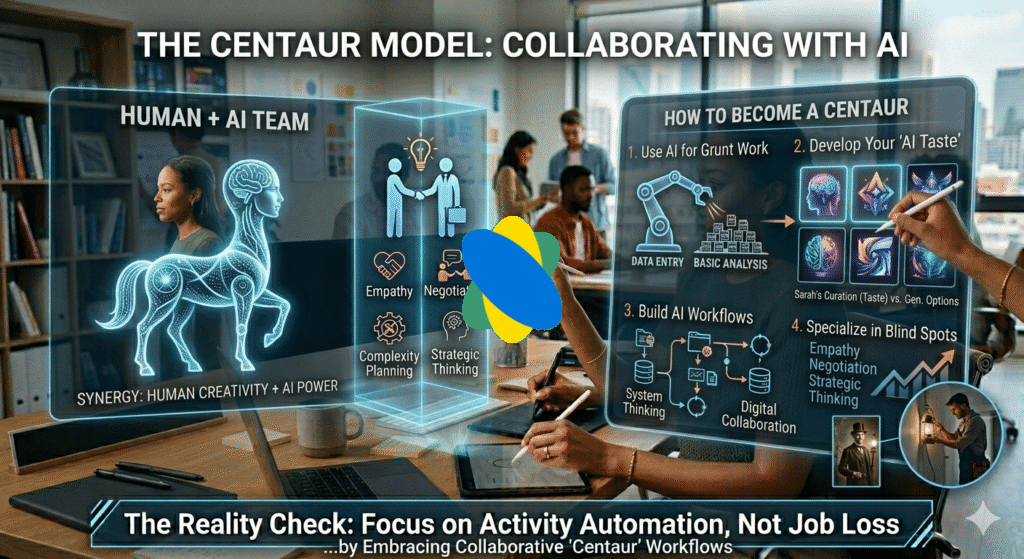
The winners in 2026 aren’t competing with AI—they’re collaborating with it.
The Centaur Model
Chess teaches us something powerful. After AI beat world champions, the most unbeatable player became a “Centaur”—a human + AI team.
How to become a Centaur in your field:
1. Use AI for the Grunt Work
Let AI handle:
- First drafts
- Data processing
- Research compilation
- Scheduling and admin
- Basic design variations
You focus on:
- Strategy
- Refinement
- Quality control
- Client relationships
- Creative direction
Example workflow (Content Creator):
- AI generates outline and first draft (15 min)
- You add expertise, personality, stories (45 min)
- AI helps with SEO optimization (10 min)
- You edit for brand voice (20 min)
Result: 4x output with better quality
2. Develop Your “AI Taste”
The future belongs to people with good “AI taste”—knowing what’s good AI output vs. mediocre.
Like a film director doesn’t operate the camera but knows great cinematography, you become the “director” of AI output.
How to develop it:
- Critique AI outputs daily
- Compare AI vs. human expert work
- Understand why something works
3. Build AI Workflows
Create systems where AI does steps 1, 3, and 5, but you do 2, 4, and 6.
Example (Marketing Manager):
Old way: 8 hours for campaign
- Market research (2 hrs)
- Competitor analysis (2 hrs)
- Campaign ideation (1 hr)
- Content creation (2 hrs)
- Report writing (1 hr)
AI-enhanced way: 3 hours for campaign
- AI does research (10 min) → You analyze (20 min)
- AI competitor analysis (15 min) → You find gaps (20 min)
- You ideate (30 min) → AI generates variations (10 min)
- AI first drafts (10 min) → You refine (30 min)
- AI generates report (5 min) → You add insights (20 min)
4. Specialize in AI’s Blind Spots
AI struggles with:
- Nuance and context → You provide it
- Ethical judgment → You make calls
- Emotional intelligence → Your superpower
- Cross-domain creativity → Connect unrelated fields
- Strategic thinking → See the bigger picture
Real success stories of people who changed direction and became successful.
Case Study 1: Maria, Former Data Entry Clerk → Data Operations Manager
The situation: Maria’s company introduced AI data processing in 2024.
Her move:
- Volunteered to learn the AI system
- Became the go-to person for training others
- Identified process improvements the AI enabled
- Pitched a new role: managing data operations + AI workflows
- Got 35% raise and job security
Key takeaway: She didn’t run from the change; she ran TOWARD it.
Case Study 2: James, Graphic Designer → Creative AI Director
The situation: AI image generators threatened his freelance business.
His move:
- Learned Midjourney, DALL-E, Stable Diffusion deeply
- Repositioned as “AI-enhanced designer” offering 3x more concepts
- Developed unique style AI couldn’t replicate
- Now uses AI for initial concepts, adds human artistry
- Doubled his rates, tripled his output
Key takeaway: AI became his assistant, not his replacement.
Frequently Asked Questions
“Will AI really take my job by 2026?”
Probably not entirely, but it will likely change it significantly. The real question: will you adapt or resist?
Most jobs won’t disappear—they’ll evolve. The question is whether you’ll evolve with them.
“I’m 50+ years old. Is it too late to learn this stuff?”
Absolutely not. I’ve seen 60-year-olds master AI tools in weeks.
Your advantages:
- Deep industry experience AI doesn’t have
- Relationship skills built over decades
- Strategic thinking from years of problem-solving
Learn just enough AI to enhance what you already do well. You don’t need to become a tech expert—just tech-competent.
“Should I go back to school for a tech degree?”
For most people: No.
Better ROI:
- Online certifications (Google, IBM, Coursera)
- Bootcamps (if changing careers entirely)
- Self-directed learning + portfolio building
A degree takes 4 years and $50k+. You can learn most skills in 6-12 months for under $2k.
Exception: If you want to become an AI engineer or data scientist, then yes, formal education helps.
Most Popular Article
https://www.hemantinsights.com/why-i-stopped-using-useeffect-for-data-fetching/